From the Renaissance to Artificial Intelligence: Why Learning Art Still Matters
-
Posted by in Art History
Over the past year many parents have asked an important question:
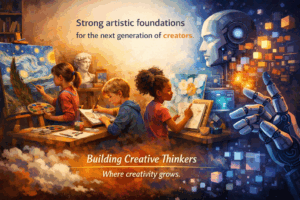
“If artificial intelligence can generate artwork instantly, does it still make sense for children to learn drawing and design?”
It’s a thoughtful concern. AI tools can now produce images that look like paintings by famous artists in seconds. But when we look at the long history of art, one thing becomes very clear: new tools have always appeared, yet the need for artistic understanding has never disappeared.
In fact, every major technological change in art history has made art education even more valuable.
Art Has Always Evolved With New Tools
Throughout history, artists have embraced new technologies.
During the Renaissance, artists such as Leonardo da Vinci and Michelangelo studied anatomy, perspective, and light to achieve realism never seen before. The development of oil paints allowed painters to create depth, subtle color transitions, and luminous textures.
Later, the invention of photography in the 19th century raised a similar concern to what we hear today:
“If cameras can capture reality instantly, will painting become irrelevant?”
Instead, the opposite happened.
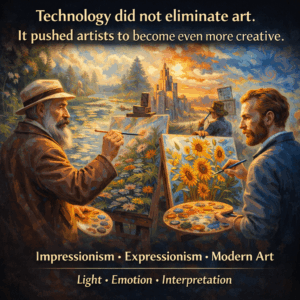
Artists responded by exploring new directions such as Impressionism, Expressionism, and modern art. Painters like Claude Monet and Vincent van Gogh focused on light, emotion, and interpretation rather than simply copying reality.
Technology did not eliminate art.
It pushed artists to become even more creative.
Artificial Intelligence Is Simply the Next Tool
Today we are witnessing another technological shift.
Artificial intelligence can analyze millions of images and generate new pictures based on prompts. While these images can look impressive, the process is fundamentally different from artistic creation.
AI does not observe the world.
It does not experience emotion.
It does not understand composition or storytelling.
Instead, it recombines patterns from existing artworks.
That means the human artist is still the one responsible for vision, meaning, and creative direction.
Just as photography did not replace painting, AI will not replace artists. It will simply become another tool used by those who understand art.
Why Artistic Foundations Matter More Than Ever
Students who learn the fundamentals of art develop skills that no algorithm can replace:
- observation
- creative thinking
- visual storytelling
- composition and balance
- understanding of light, form, and color
These foundations allow artists to create images that communicate ideas and emotions.
Without those foundations, even the most advanced tools cannot produce meaningful work.
The future will not belong to people who simply generate images.
It will belong to people who understand how to shape ideas visually and guide technology with creative intention.
What Children Gain From Learning Art
Art education teaches far more than drawing techniques. Students learn to:
- think critically and creatively
- solve visual problems
- develop patience and discipline
- communicate ideas through images
- build confidence in their own creative voice
These are the same skills that have helped artists innovate throughout history, from Renaissance masters to modern designers and filmmakers.
In an increasingly automated world, these human abilities become even more valuable.
Preparing Young Artists for the Future
At Art One Academy, our curriculum focuses on building strong artistic foundations through drawing, painting, sculpture, and design. Students gradually develop the ability to observe the world carefully and translate their ideas into visual form.
This foundation prepares students not only for traditional art paths but also for future creative industries where technology and creativity intersect.
Students who understand art will not be replaced by AI.
They will be the ones who use it as a tool to expand their imagination.
The Real Value of Learning Art
Art has survived every technological revolution for thousands of years because it reflects something deeply human: our desire to interpret the world and express meaning.
Artificial intelligence may be able to generate images. But only artists can create ideas worth seeing. And that is why learning art will always matter.